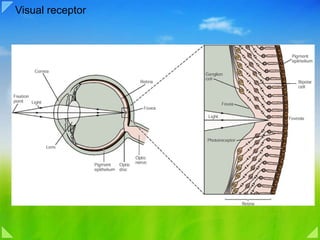
Visual receptor
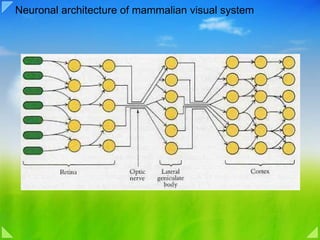
Neuronal architecture of mammalian visual system
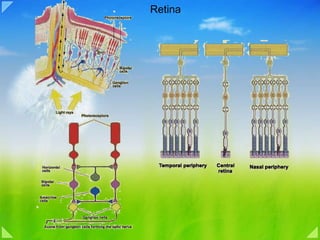
Retina
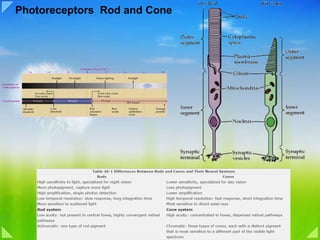
Photoreceptors  Rod and Cone
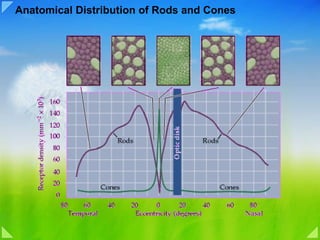
Anatomical Distribution of Rods and Cones
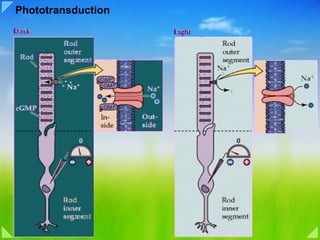
Phototransduction
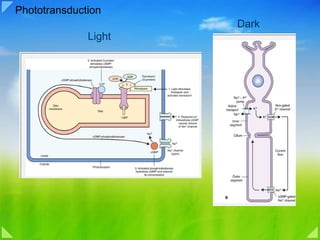
Phototransduction Light Dark
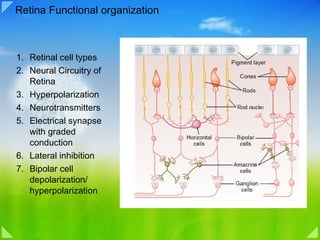
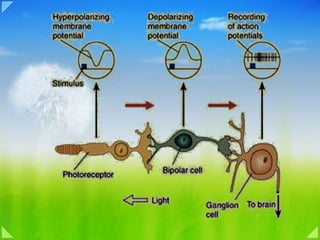
Retina Functional organization Retinal cell types Neural Circuitry of Retina Hyperpolarization Neurotransmitters Electrical synapse with graded conduction Lateral inhibition Bipolar cell depolarization/ hyperpolarization
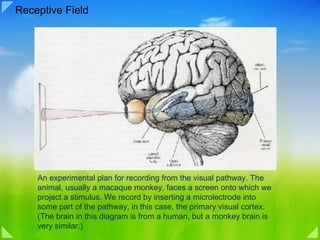
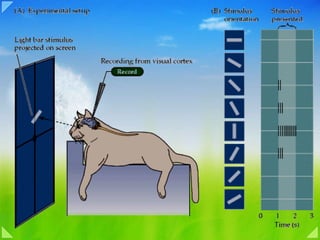
Receptive Field An experimental plan for recording from the visual pathway. The animal, usually a macaque monkey, faces a screen onto which we project a stimulus. We record by inserting a microlectrode into some part of the pathway, in this case, the primary visual cortex. (The brain in this diagram is from a human, but a monkey brain is very similar.)
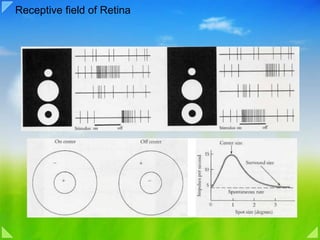
Receptive field of Retina
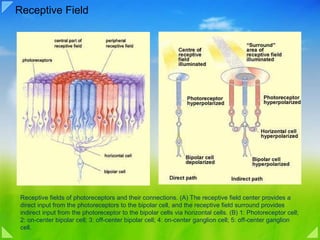
Receptive Field Receptive fields of photoreceptors and their connections. (A) The receptive field center provides a direct input from the photoreceptors to the bipolar cell, and the receptive field surround provides indirect input from the photoreceptor to the bipolar cells via horizontal cells. (B) 1: Photoreceptor cell; 2: on-center bipolar cell; 3: off-center bipolar cell; 4: on-center ganglion cell; 5: off-center ganglion cell.
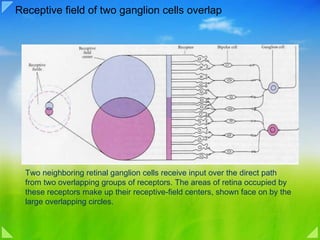
Receptive field of two ganglion cells overlap Two neighboring retinal ganglion cells receive input over the direct path from two overlapping groups of receptors. The areas of retina occupied by these receptors make up their receptive-field centers, shown face on by the large overlapping circles.
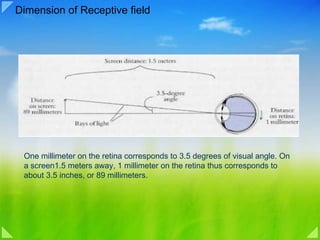
Dimension of Receptive field One millimeter on the retina corresponds to 3.5 degrees of visual angle. On a screen1.5 meters away, 1 millimeter on the retina thus corresponds to about 3.5 inches, or 89 millimeters.
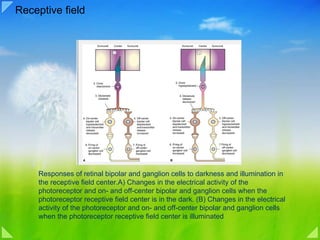
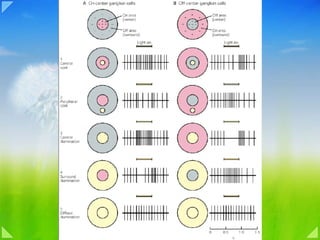
Receptive field Responses of retinal bipolar and ganglion cells to darkness and illumination in the receptive field center.A) Changes in the electrical activity of the photoreceptor and on- and off-center bipolar and ganglion cells when the photoreceptor receptive field center is in the dark. (B) Changes in the electrical activity of the photoreceptor and on- and off-center bipolar and ganglion cells when the photoreceptor receptive field center is illuminated
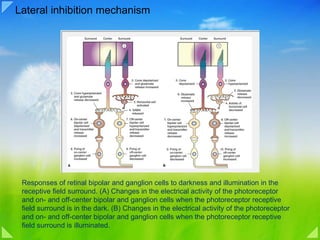
Lateral inhibition mechanism Responses of retinal bipolar and ganglion cells to darkness and illumination in the receptive field surround. (A) Changes in the electrical activity of the photoreceptor and on- and off-center bipolar and ganglion cells when the photoreceptor receptive field surround is in the dark. (B) Changes in the electrical activity of the photoreceptor and on- and off-center bipolar and ganglion cells when the photoreceptor receptive field surround is illuminated.
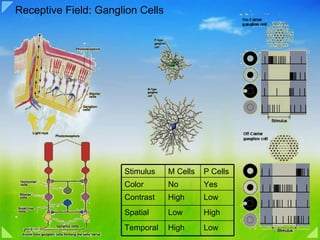
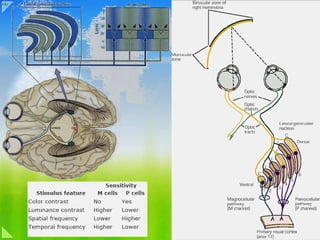
Receptive Field: Ganglion Cells  Stimulus  M Cells P Cells Color No Yes Contrast High Low Spatial  Low High Temporal High Low
 
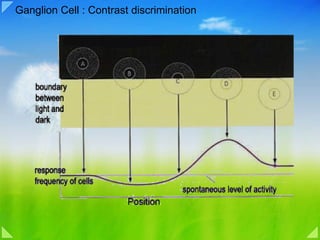
Ganglion Cell : Contrast discrimination
 
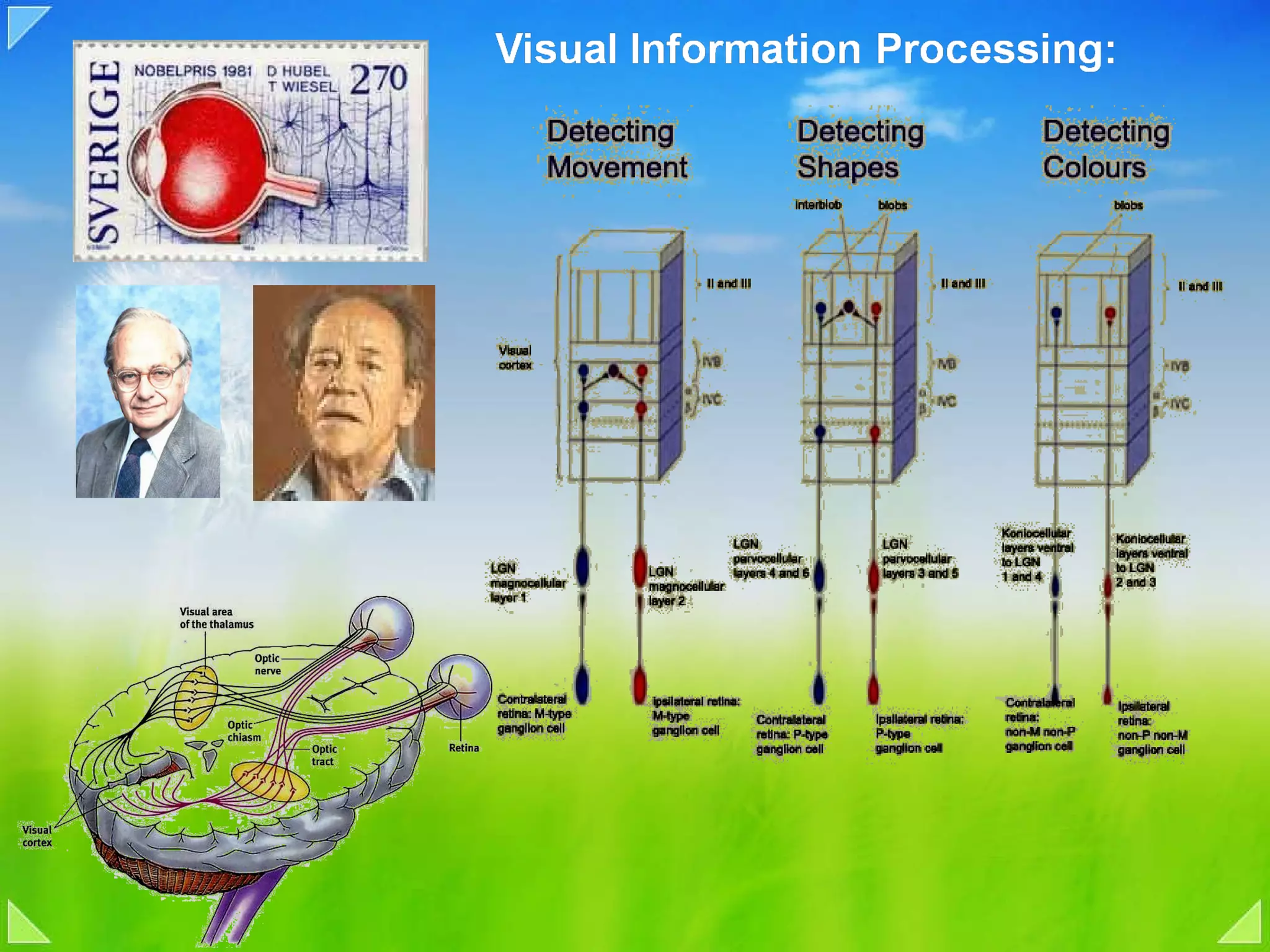
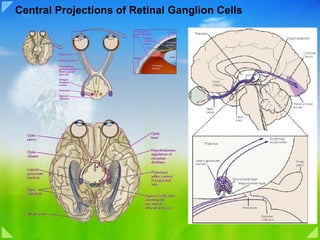
Central Projections of Retinal Ganglion Cells
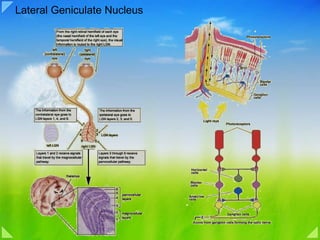
Lateral Geniculate Nucleus
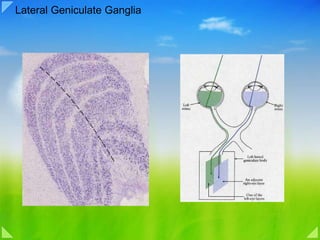
Lateral Geniculate Ganglia
 
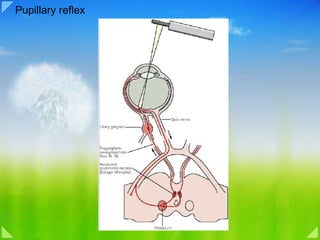
Pupillary reflex
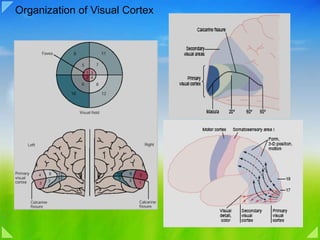
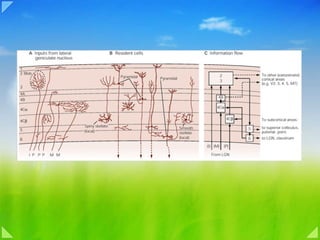
Organization of Visual Cortex
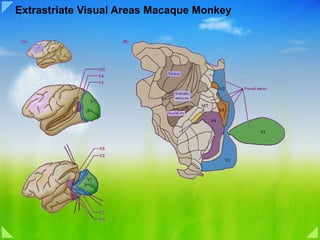
Extrastriate Visual Areas Macaque Monkey
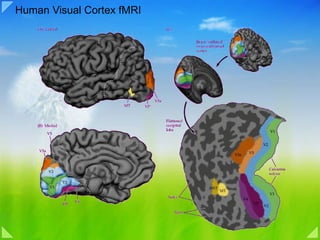
Human Visual Cortex fMRI
 
 
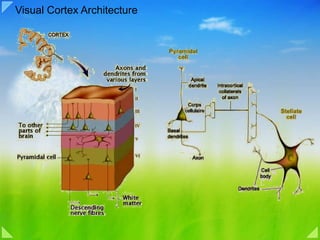
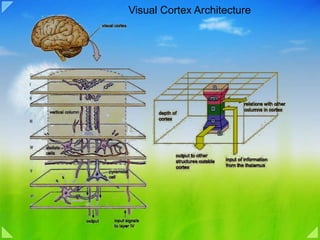
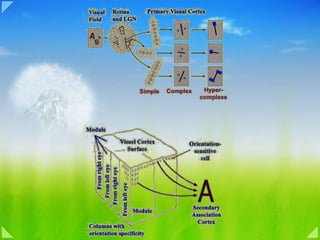
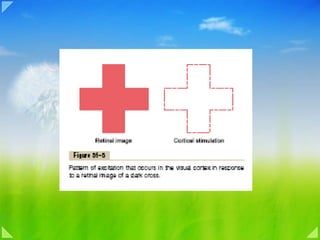
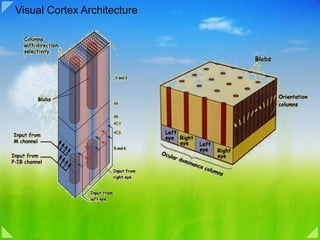
Visual Cortex Architecture
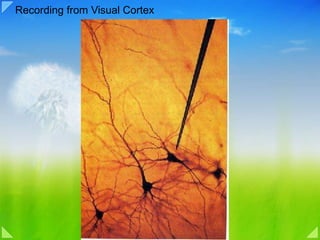
Recording from Visual Cortex
 
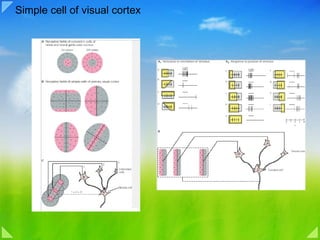
Simple cell of visual cortex
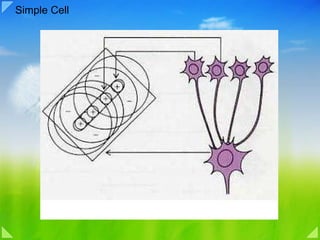
Simple Cell
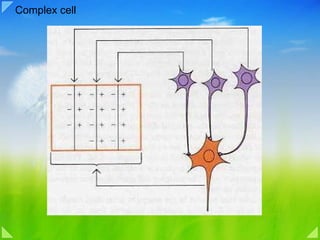
Complex cell
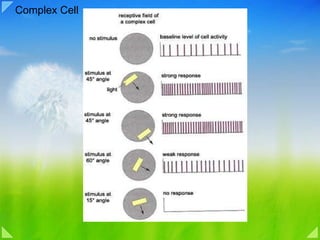
Complex Cell
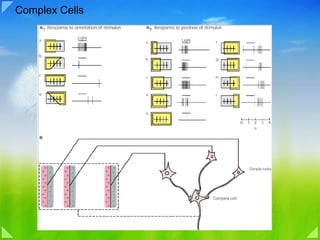
Complex Cells
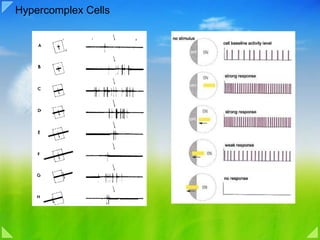
Hypercomplex Cells
 
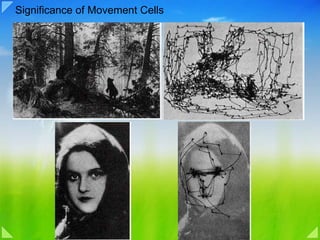
Significance of Movement Cells
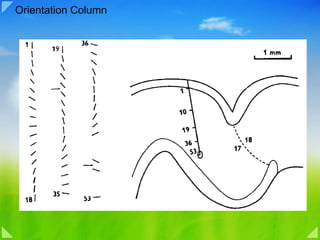
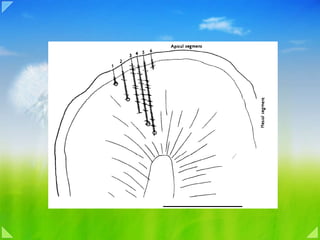
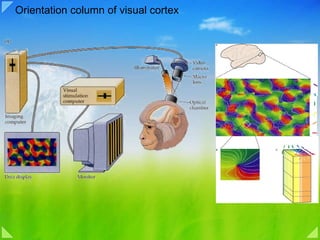
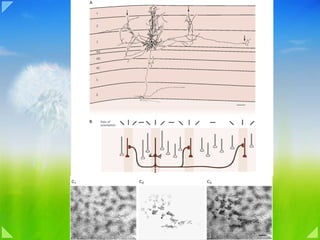
Orientation Column
 
Orientation column of visual cortex
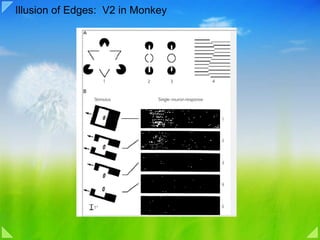
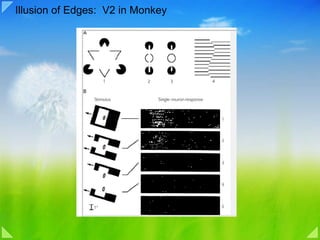
Illusion of Edges:  V2 in Monkey
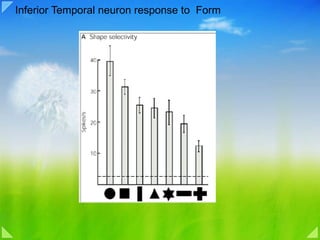
Inferior Temporal neuron response to  Form
 
Illusion of Edges:  V2 in Monkey
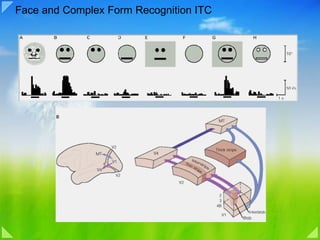
Face and Complex Form Recognition ITC
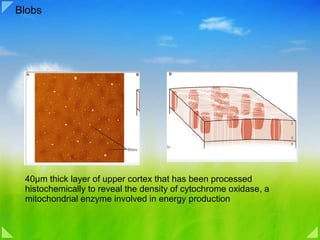
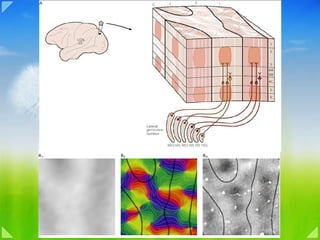
Blobs 40μm thick layer of upper cortex that has been processed histochemically to reveal the density of cytochrome oxidase, a mitochondrial enzyme involved in energy production
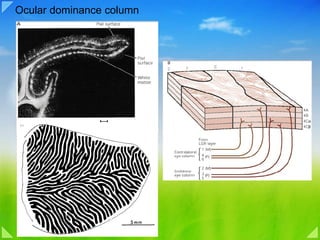
Ocular dominance column
 
Visual Cortex Architecture
 
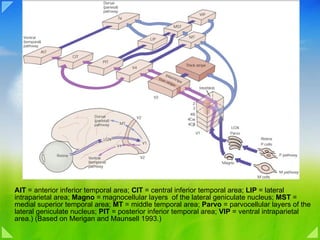
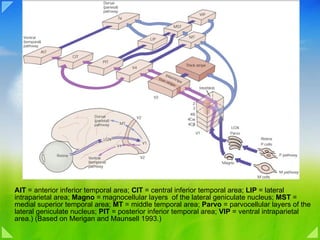
AIT  = anterior inferior temporal area;  CIT  = central inferior temporal area;  LIP  = lateral intraparietal area;  Magno  = magnocellular layers  of the lateral geniculate nucleus;  MST  = medial superior temporal area;  MT  = middle temporal area;  Parvo  = parvocellular layers of the lateral geniculate nucleus;  PIT  = posterior inferior temporal area;  VIP  = ventral intraparietal area.) (Based on Merigan and Maunsell 1993.)
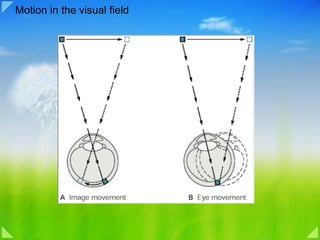
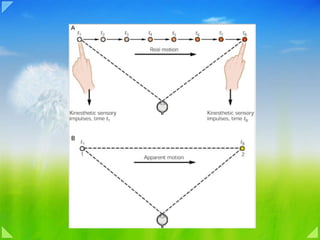
Motion in the visual field
 
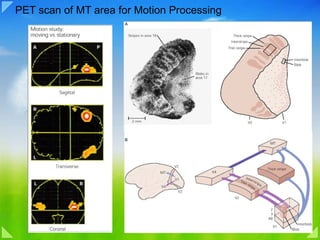
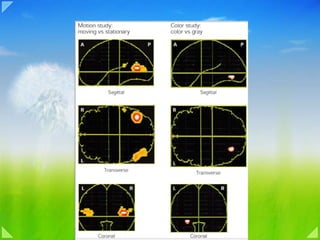
PET scan of MT area for Motion Processing
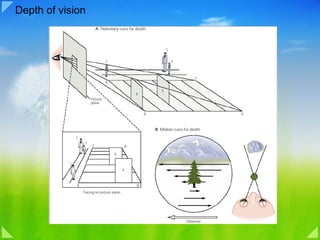
Depth of vision
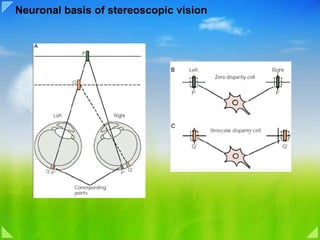
Neuronal basis of stereoscopic vision
AIT  = anterior inferior temporal area;  CIT  = central inferior temporal area;  LIP  = lateral intraparietal area;  Magno  = magnocellular layers  of the lateral geniculate nucleus;  MST  = medial superior temporal area;  MT  = middle temporal area;  Parvo  = parvocellular layers of the lateral geniculate nucleus;  PIT  = posterior inferior temporal area;  VIP  = ventral intraparietal area.) (Based on Merigan and Maunsell 1993.)
 
 
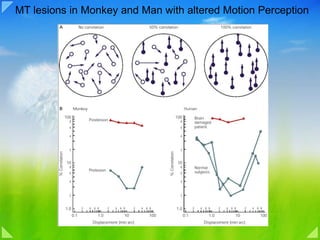
MT lesions in Monkey and Man with altered Motion Perception
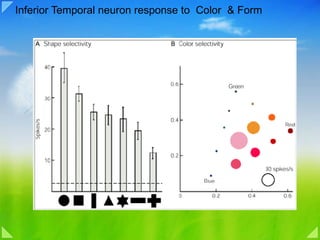
Inferior Temporal neuron response to  Color  & Form
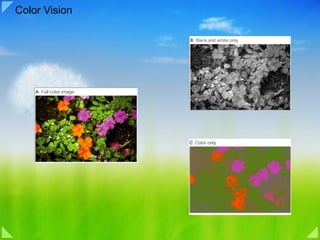
Color Vision
 
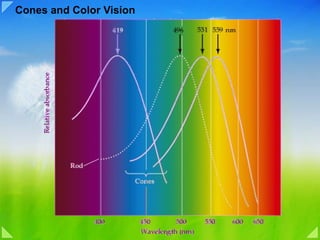
Cones and Color Vision
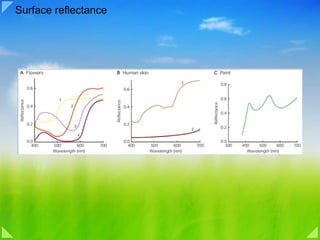
Surface reflectance
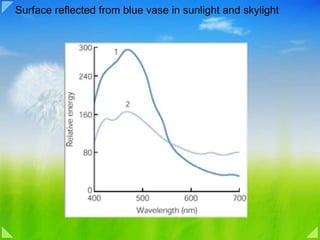
Surface reflected from blue vase in sunlight and skylight
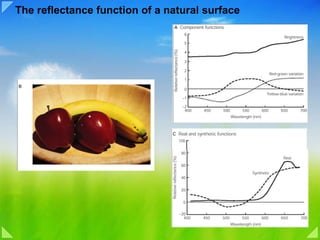
The reflectance function of a natural surface
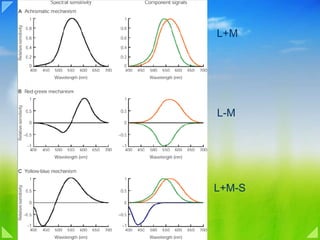
L+M L-M L+M-S
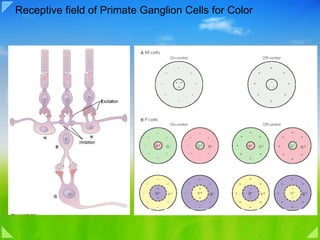
Receptive field of Primate Ganglion Cells for Color
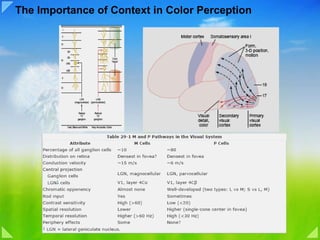
The Importance of Context in Color Perception
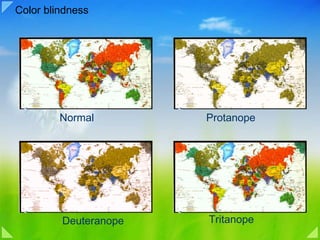
Color blindness Normal Protanope  Deuteranope  Tritanope
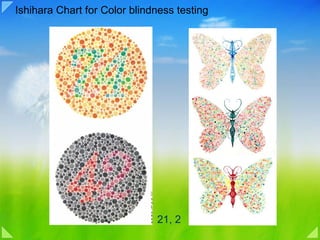
Ishihara Chart for Color blindness testing 21, 2

08a vision processing intorduction